
Franklin County Deed Types and Uses
A deed transfers or describes an interest in land. Other recorded instruments do different work. Some secure a loan. Some release a claim, and some set out a right of way. The Circuit Court Clerk's land-record index gathers these instruments into families. The table below names record types the county documents. It is not a promise of a matching filter for every one.
| Instrument | What it does | Why it may appear |
|---|---|---|
| Warranty or other deed | Records a conveyance of an interest in land | Sale, gift, or transfer between parties |
| Deed of trust | Records security tied to a loan | Financing associated with the property |
| Release or satisfaction | Records that a secured interest was discharged | Later event after a deed of trust |
| Correction deed | Corrects or clarifies an earlier instrument | Fixes a description or other recorded detail |
| Plat, easement, or right of way | Maps a tract or records access and use rights | Subdivision, access, utility, or boundary context |
Judgments, assignments, liens, and lis pendens can matter too. A lis pendens gives notice of litigation affecting land. It is not a judgment, and it resolves nothing by itself. Read the instrument and follow any later releases or orders before drawing a conclusion from an index line.
The Franklin County Grantor-Grantee Index
Virginia SRA is the statewide remote access system for land records kept by circuit-court clerks. Its core chain method searches parties as grantor and grantee. A grantor conveys an interest; a grantee receives it. To move backward, find the current owner's acquisition as grantee. Note the prior grantor. Then search that person as a grantee in an earlier instrument. Repeat with book/page or document references so each step concerns the same land.
The Franklin County Clerk's office sits at the courthouse. The address is 275 S Main Street in Rocky Mount. The local directory lists 540-483-3065 and weekday hours of 8:30 a.m. to 4:30 p.m. A courthouse terminal or a staff-assisted request works when a remote search comes up short. Remember that SRA searches the land-record index only. It is not the full civil-case docket. It also never replaces reading the instrument image itself.
- Grantor
- The party transferring an interest.
- Grantee
- The party receiving an interest.
- Instrument
- A recorded legal document, such as a deed or release.
- Book and page
- A volume and page reference used to retrieve an older record.
- Chain of title
- The ordered sequence of recorded transfers affecting a parcel.
Need the parcel before opening the index? Use the Franklin County property search to go from an address to a parcel. The deed lookup begins once you have the parcel or a likely party name.
Free Index, Limited Image Access
The Virginia courts' SRA information says some circuit clerks enable free, index-only access. There is no login. Document images are another matter. Access is limited to subscribers authorized by the individual clerk. It may involve an agreement and fees. Franklin County publishes no current image cutoff, subscription terms, or copy prices online. Ask the Clerk before treating a search result as a complete copy. Do not pay a third party without checking first.
The distinction matters in practice. An index line gives parties, instrument type, recording date, and a deed-book/page or document reference. The image lets you review the legal description, signatures, acknowledgments, and terms. If the image is not available remotely, ask about counter viewing, a courthouse terminal, or a copy request. Not every indexed instrument has an online image.
The Virginia SRA access page explains the statewide index and image model. Its available-courts information shows whether a local court participates and which access tier applies.
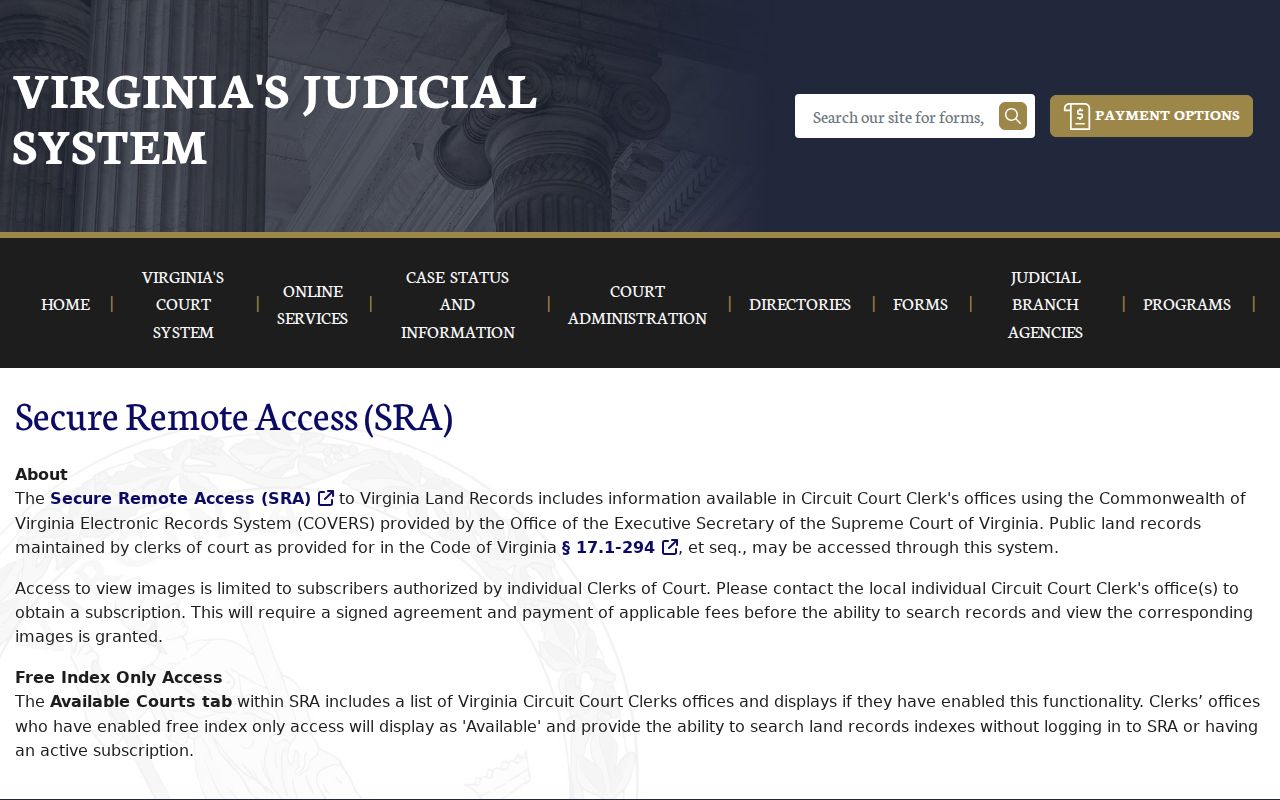
The official SRA page displays the statewide system's access rules rather than a Franklin County instrument result. Confirm local coverage and image access with the Clerk.
Franklin County Deed Search Fields
The SRA index model is consistent, but the live Franklin County form may vary. Use party names first. Narrow by date or instrument type only when those fields appear in the current interface. The record reference is the key to any clerk request. Name searches can return unrelated people. So compare dates, parcel references, and legal descriptions before selecting a result.
| Index item | Known purpose | What remains to verify |
|---|---|---|
| Grantor name | Searches a party who conveyed or held an interest | Exact text rules and required format |
| Grantee name | Searches a party receiving an interest | Partial-match and punctuation behavior |
| Instrument type | Relevant categories include deeds, releases, plats, and easements | Current list of selectable types |
| Date range | Can narrow a common name search when available | Live field names and range limits |
| Book/page or document number | Reference for retrieval from the clerk | Which reference formats the form accepts |
Do not guess when the form behaves differently. Call the Clerk with the party names, an approximate date, and the parcel ID. That gives staff a practical way to separate a deed from an unrelated filing.
Getting a Franklin County Deed Copy
An index result points to a specific instrument. Write down the grantor, grantee, instrument type, recording date, and book/page or document number. Ask the Circuit Court Clerk whether the image can be viewed at a public terminal. It may also be obtained by mail, or ordered as a plain or certified copy. The office sets the fee. Request the current price and delivery method before sending payment. Not every image can be delivered remotely.
A certified copy carries the clerk's certification; an ordinary copy does not. The right choice depends on why you need it. Keep the record reference with your copy. Keep the parcel's legal description there too, so it is not confused with another tract. When a record is unclear, request the full instrument. Do not rely on a search-result summary.
Index is not title review. A search identifies recorded entries. It does not find every unrecorded claim or determine whether a chain is legally clear. A transaction or legal dispute may call for a title professional.
For earlier transfers and how to follow them, see the Franklin County former-owners page. This section covers retrieval of a single recorded instrument.
Franklin County Deed Books, 1786 to 1901
Franklin County was formed in 1786 out of Bedford and Henry Counties. Its deed record runs deep. The Library of Virginia catalog begins with Deed Book 1 covering 1786 to 1789. It continues through Books 2 to 4 into 1804 and reaches Book 49 by 1901. Grantor and grantee indexes spanning 1786 to 1897 sit on A-to-K and L-to-Z reels. The catalog does not publish a starting year for the online SRA. So treat it as a separate route rather than proof the online search reaches the same early years.
The same catalog holds more than deed books. District-court deed books run from 1789 to 1814. There is a land-suits index for 1805 to 1818. Trust Deed Book A covers 1900 to 1907, plus fiduciary and order-book material. Collection notes in the catalog can frame a request. The Clerk or library staff can also clarify original custody, reproduction options, and interlibrary loan before a retrieval plan.
The Franklin County microfilm finding aid lists the historic land-book and index runs. It works as a year-specific fallback. Use it whenever current online property records do not reach back far enough.
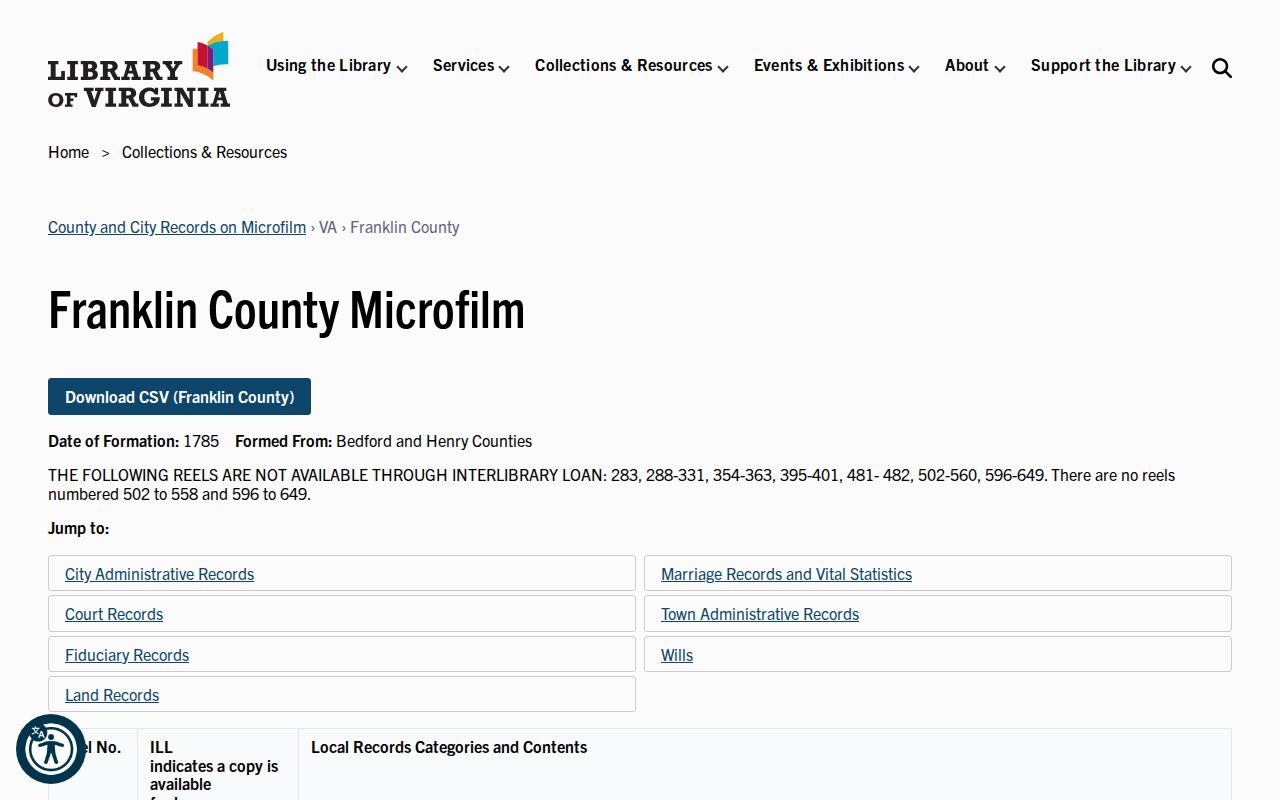
Identify the book or reel in the catalog first. Then confirm viewing and ordering with the holding institution.
Franklin County Plats and Land Descriptions
Plat books add a map layer to the deed trail. The Library of Virginia catalogs Plat Book 1 for 1792 to 1811 and Plat Book 2 for 1809 to 1891. A recorded plat can show lot divisions, roads, easements, and named neighbors. A rural deed may instead use metes and bounds, a creek, a ridge, an old road, or adjoining landowner names. Comparing the deed text with a plat can help explain how a modern parcel relates to an older tract.
Franklin County's 1870 district map is another useful locator. District names changed over time. Later records may use a district name that no longer appears on an address card. Do not rewrite an old description into a present-day road name without checking the actual geometry and references. The county's GIS is helpful for orientation, but the recorded plat and deed carry the source language.
The county requires tax-map parcel identification on land-record cover sheets under Virginia Code §17.1-252. That ID helps connect the modern parcel to a deed or plat but does not replace the legal description.
Use Official Franklin County Sources
Commercial record directories can help a researcher learn the terminology. They are not the custodian, though. The secondary deed-index explainer describes a Franklin grantor-grantee workflow. It is a secondary reference rather than an official county service. Confirm any claim it makes with the Clerk. For an actual deed, use Virginia SRA, the Circuit Court Clerk, or the historical collections identified by the Library of Virginia. Do not send money, personal information, or a copy request to any service. Wait until its role and fee are clear.
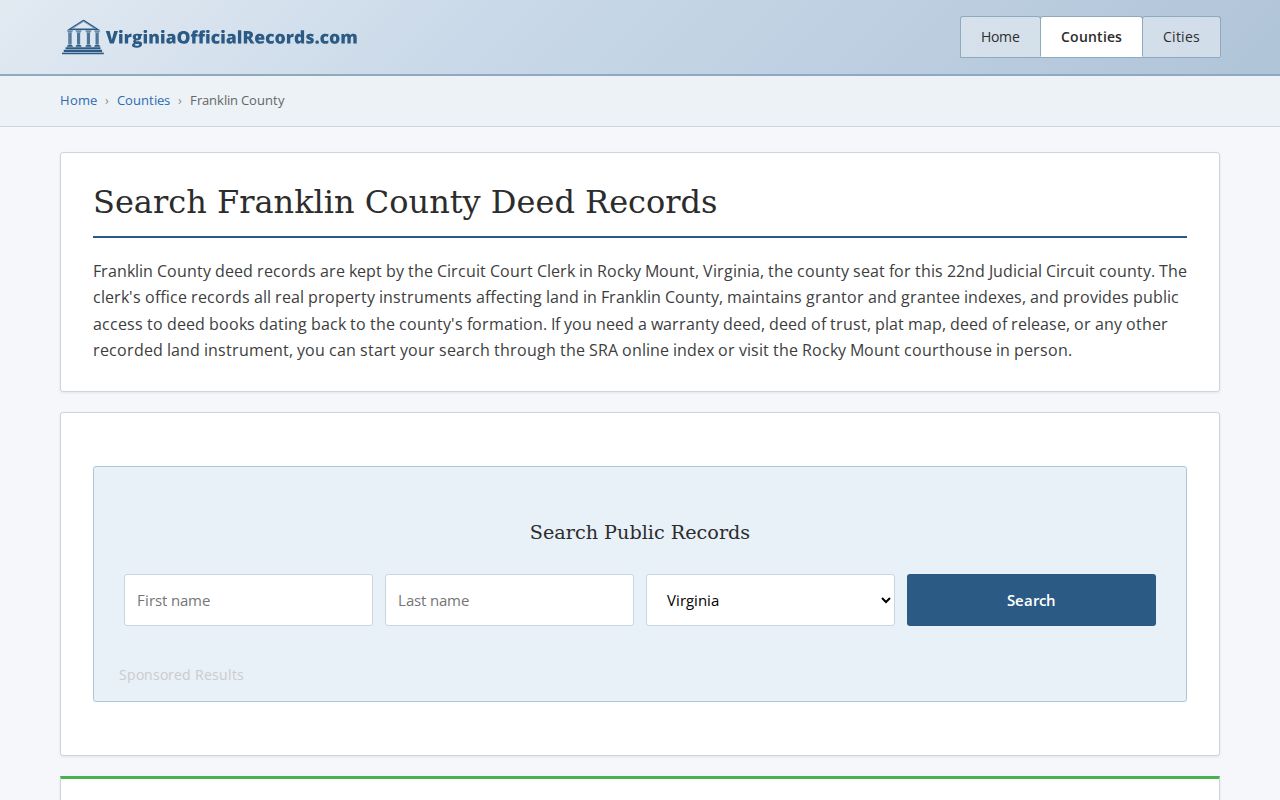
Third parties can describe the process. Only the Franklin County Clerk and Virginia courts remain the authoritative route for recorded instruments.